Madgack Labradors
Contact us at 07890 052479 or use the contact us form.
  • Home
  • About us
  • Alys
  • Sula
  • Prue
  • Monty
  • Baxter
  • Elsie
  • Puppies
  • Puppy Blog
  • Health Testing
  • Buying a puppy
  • Training
  • Gallery

Socialisation Period Handling

11/27/2016

0 Comments

 
Picture
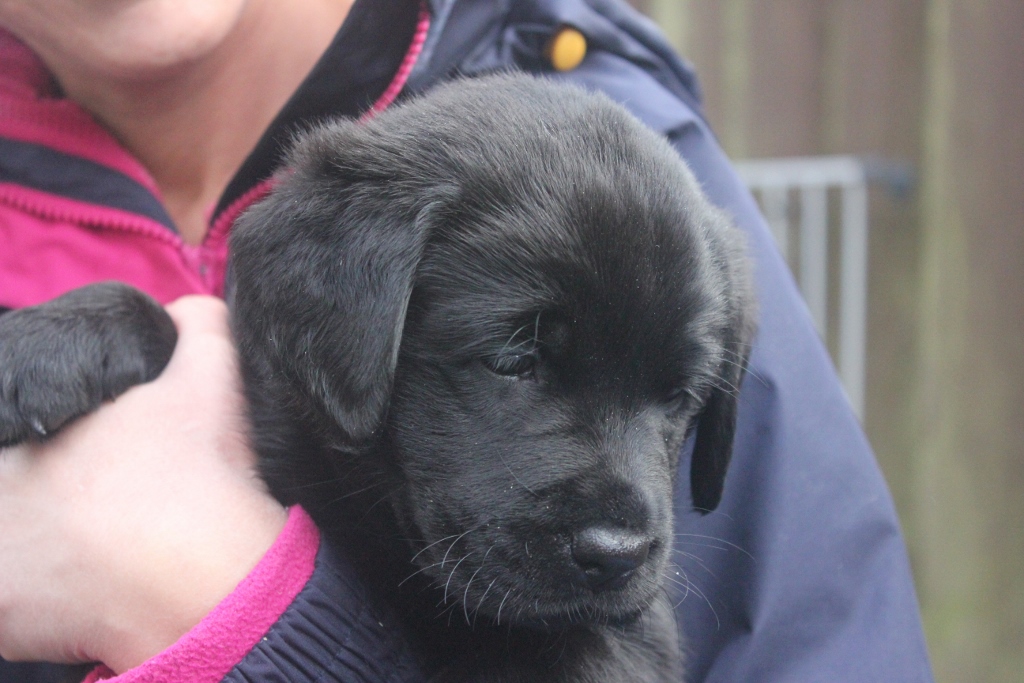
Puppies need to be handled a lot from a very young age to accept handling better more happily as adults.

Elsie's puppies have had their nails clipped numerous times from as young as a week old. Their nails grow so fast and it is so important to get them used to being handled for this procedure.

There will always be puppies who cope with being restrained better than others, however it is important - if puppies struggles to wait until they are still (even if this is only for a fraction of a second) before you put them down and release them.  

Again it is important to build positive associations between the handling and something good.

I have used the same protocol with handling the puppies as we use in our puppy classes which involves the following;

Pick up puppies paw - give a small piece of chicken.
Pick up puppies paw and squeeze gently - give a small piece of chicken
Feel around the claws including the dew claw.
Fold back puppies ears and examine them gently - repeat good experiences after each handling exercise
Look at puppies eyes
Feel around puppies lips
Look at puppies teeth
Run hands all over puppies body
Repeat handling of paws with back paws
Gently pull out puppies tail away from their body
Hug puppy gently - before releasing and rewarding.
Hug puppy gently and look into puppies eyes before releasing and rewarding

Most dogs dislike being hugged - most dogs will tolerate it, but it is an unnatural experience for them. We are humans like to hug, we are a primate species. Dogs are not primates and do not hug one another, and it is something that some dogs find a very scary experience. Many children are bitten whilst hugging dogs, or putting their face close to dogs as the dogs become frightened. Obviously this behaviour also depends on the temperament and past experiences of the dogs too.

If more breeders practiced these desensitisation activities our puppies would be better equipped when out in the big wide world to deal with this behaviour.

How often have you been out in the park when a stranger has approached your dog, leaned over it, made eye contact and gone in to stroke or touch the dog? We need our dogs to be comfortable with this :)


0 Comments

Socialisation Period  6 Weeks

11/27/2016

0 Comments

 
Picture
Since the puppies have reached the age of 6 weeks old we have been introducing new people and new activities each day.

Picture
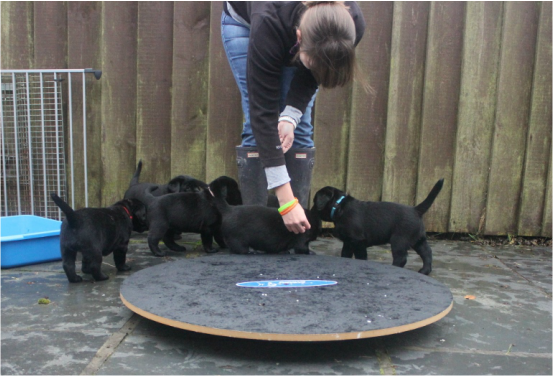
The puppy play area has wobble boards, a canine fitness step for them to climb over, wobble cushions and a ball pit.

Each puppy has been encouraged to walk over or interact with the different pieces of equipment using small pieces of chicken as reinforcement. This helps the puppies to gain confidence by making sure the puppies have positive experiences.
The puppies have also been out and about on the lawn, taking in all the new smells, sounds and sights of the outdoors.

The puppies are beginning to be more choosy about where they toilet and are using the toilet area at the end of their pen most of the time. Puppies raised in a clean environment will be easier to toilet train as they are used to being clean.

0 Comments

Socialisation Period 5 Weeks

11/21/2016

1 Comment

 
Picture
As the puppies reach 5 weeks old their reactions to unfamiliar objects or noises may change slightly.

At 5 weeks old puppies will go through what is commonly referred to as a short 'fear period' - where they may become more unsure of an object or situation that they were previously comfortable with. This has been quite noticeable with a few of Elsie's puppies - some more than others.

As the puppies pass through this 'fear period' it is important to keep triggering that startle recovery process however proceeding with a little more caution that previously needed. The puppies need only to experience very mild startles and they need to recover immediately. It is also important to continue introducing new and novel objects at this time.

We introduced the puppies to the great outdoors at this time. The puppies have immunity from their mother that will last until they are approximately 8 weeks old so they are relatively safe to do this. Introducing the puppies to the outdoors, the smells, the surfaces - including grass is so important to young puppies. The puppies took it all in their stride and loved running through the grass!

The Puppy Culture program also emphasises the importance of communication between dogs and people, calling this the Communication Trillogy.

1.  Introducing a marker or in our case a 'clicker'
2.  Teaching puppies to offer behaviour to gain a response.
3.  Manding - offering a sit behaviour to ask for attention/rewards.

Introducing these exercises can also support the development of impulse control, which is defined as the ability to delay gratification. Teaching the puppies to offer behaviours  - teaches the puppies impulse control. For example a puppy that wants attention could obtain instant gratification by jump up to gain attention - or if it has been taught to offer a suitable behaviour like a sit for attention (Manding) then this becomes that default behaviour instead. Teaching these behaviours can also help to reduce frustration as the puppy know what to do to gain that all important attention it wants.

Many people worry that teaching a 'sit' behaviour to puppies will prevent them being showdogs in the future.  This is simply not true. You just need to teach a stand behaviour too and then introduce commands (cues) so that the puppy understands the difference. Its a little extra work but well worth it!

We have already introduced the puppies to the clicker. Pairing the sound of the clicker with a small piece of chicken. Needless the puppies were very excited by the presence of the chicken and were not worried at all by the clicker. They all love training...

Now to begin the exercises.....


1 Comment

Socialisation Period  4 weeks

11/10/2016

0 Comments

 
At four weeks old the puppies are getting stronger on their feet and are starting to pounce at each other, and bite and shake toys.

They now have a bigger puppy pen so that they can stretch their legs and exercise. Physical fitness also improves mental fitness. The larger pen also reduces conflict within the litter allowing them space to move away from each other if they want to.

I've now created a toilet area with trays and puppy pads to teach the puppies to use the toilet area rather than the whole exercise area! (This has been added since the picture was taken).

The addition of the toilet tray should make toilet training easier for the new owners when they take their puppies home.
Picture
Picture
At 4 weeks the puppies have virtually no fear response so now is the time to introduce other friendly dogs in the household too. Baxter loves the puppies and is happy to let them follow him around.

A large pen with environmental enrichment has a huge impact on the puppies, however adding learning and problem solving activities can improve that enrichment affect even further

Learning and enrichment activities produce puppies that are more stable, less prone to stress and less easily frightened.

We have started adding new challenges to the puppies lives daily.
The problem solving activities we have introduced are;
1.  We have started to feed the puppies away from the play pen, requiring them to navigate the slightly raised lip of the lip of the door to obtain their food. We are obviously aware that Labrador puppies have joints that are very underdeveloped so small raised platforms have also been introduced - I'll have to take some photos to upload on here!
2. We are also going to introduce simple barrier activities, placing a bowl of food one side of a barrier and the puppy on the other. The puppies can get to the food easily by navigating around the barrier - but the puppies need to work this out for themselves. 
Puppies NEED to learn how to cope with frustration, and be able to think and work things out for themselves in order to cope with everyday life. These activities teach the puppies how to cope with frustration.  Frustration is a huge factor in aggressive behaviour. If all puppies were taught how to cope with frustration from a young age, the incidences of aggression would probably be a lot lower.
My behavioural work through my business 'Puppy Plus' brings me into contact with lots of dogs who do not cope with being frustrated - dogs that bark and lunge when they cannot get to other dogs, dogs that turn and bite their owner when they see something that they want to get to. It's very sad and can cost those dogs their lives.
Elsie has a fantastic temperament, partly due to her breeding and partly due to the fantastic start in life that she had from her breeder Hayley Brambles of Shaymiloney Labradors.
I am determined that Elsie's puppies will have that same fantastic start! x
0 Comments

Socialisation Period 3 weeks old

11/10/2016

0 Comments

 
At 3 weeks old Elsie's puppies can solicit and extend invitations to play and they have an emotional response to new experiences and situations.

Elsie has begun to interact with the puppies more socially and is beginning to bond with them in a different way. The quality of the bitches interactions with the puppies has an impact on the puppies for the rest of their lives.

Allowing Elsie to move away from the puppies when she want to is so important at this stage.

A bitch that feels that she is trapped with the puppies may growl or snarl at the puppies to gain space - studies have shown that puppies born to bitches who growl at their own puppies grow up to be less outgoing, and less confident approaching strangers.

Allowing Elsie the space to move away when she wants allows her to spend time with her puppies but on her terms.

Baxter my chocolate Labrador visits the puppies regularly but again has the space to move away if he chooses too.
At 3 weeks old the puppies will be doing lots of growling and posturing towards one another. They are learning to communicate and this is nothing to worry about. The puppies need to learn how to communicate with other dogs if they need to cope as stable adult dogs in the future.

I am also cutting the puppies nails regularly as they grow so fast. This makes feeding more comfortable for Elsie and also desensitises the puppies to having their feet and nails handled in the future. This is a must for all puppies as nail cutting should be a comfortable experience for an adult dog - not something that they are frightened of.
Picture
At three weeks old Elsie's puppies are being introduced to a new toy or new visual object each day.

Studies have shown that puppies raised in a stimulus rich environment with exercises and challenges, grow up to have larger brains with more neural connections than animals raised in stimulus poor environments. Puppies raised in a stimulus rich environment can actually have brains that are 5% bigger. (Puppy Culture)

What does this mean?
  • Better learning
  • Better memory
  • More stable emotional responses.
As a result of this enrichment Elsie's puppies should have more stable temperaments with less fearful responses.
It is important that the socialisation process is started with people is started during week three as puppies need to become habituated to people to avoid fearful responses later. At 3 weeks old the puppies still have maternal antibodies to protect them from disease, however safety precautions such as washing hands and removing shoes is still important!

Elsie puppies have already met a range of people, including family, friends and prospective puppy owners :)

At 3-4 weeks old we have also begun to teach 'Emotional Resilience'.

A dogs ability to recover from fear is so important. Dogs that don't recover from fear quickly can lead restricted and fearful lives. Fear can affect where a dog can go and what they can cope with, dogs who show fearful behaviours can also develop aggressive behaviours. Through my behavioural work I know the impact aggression can have on people's lives and understand the importance of teaching puppies this emotional resilience.  

To teach emotional resilience involves triggering the startle recovery process at 3-4 weeks old. The more times a puppy is startled and recovers during this time, the more resilient they will grow up to be as adults. At 3 weeks old the puppies have virtually no fear response.

At three weeks old Elsie's puppies are being taken away from the other puppies individually as much as possible. This can help to prevent separation anxiety later in life. If being separated on a regular basis becomes normal the puppies see this as an ordinary occurrence and become habituated to that situation. Separation anxiety experienced by an adult dog can have a huge impact on a dogs quality of life and that of their owner.
0 Comments

Socialisation Period   3 - 12 weeks old.

11/10/2016

0 Comments

 
Picture
Elsie puppies are now three weeks old. The socialisation period is scientifically defined as being from around 3 weeks until 12 weeks of age.

During this time little time and effort is needed to produce huge emotional changes. As the puppy gets older this socialisation window closes and greater time and effort is needed to produce even small emotional change.

A puppy introduced to a new person at 3 weeks old will recover quickly from the introduction and soon realise that people are safe. A 8 month old dog introduced to people or an unfamiliar person may not cope well,  and will take so much longer to develop an understanding that people are safe for that dog.
At over 12 weeks of age there is a change in brain chemistry that makes it so much harder for the dog to cope with new, unfamiliar noises, people, dogs etc.

Socialisation is so much more than explosive to new and novel situations although this is obviously a bit part of it. Dogs need to develop social behaviours, social behaviour around other dogs and social behaviour around people. Dogs need to become emotionally intelligent.

During the socialisation period the dogs need to become familiar with 7 key things;
  • Communication
Puppies need to learn the dog and human communication skills that will allow them to communicate and function in our society as adult dogs.
  • Emotional Stability
Puppies need to learn how to recover easily from fear and to be able to cope with stress in their every day lives.
  • Habituation
Puppies need to be familiarised with different people, animals, dogs, and situations as possible during this time.
  • Enrichment
Puppies need enrichment to be able to cope with novelty and challenge as adult dogs.
  • Health
Physical as well as mental fitness
  • Skills
Puppies need to learn behaviours that will help them to fit into our world.
  • Love
Puppies need to learn to have the desire to seek out people and other dogs and see these experiences as emotionally positive experiences.

For more information on this see www.puppyculture.com

0 Comments

    Puppy Blog

    This Blog follows the development stages of our puppies lives from the Prenatal Period, through the Neonatal and Transitional periods to the Critical Socialisation Period up to 12 weeks old.

    Archives

    April 2020
    March 2020
    March 2018
    December 2017
    April 2017
    December 2016
    November 2016
    October 2016

    Categories

    All

    RSS Feed

Powered by Create your own unique website with customizable templates.